Category: Electronics

  • Radioactive film lenses and Geiger counter Kit

    The Super-Takumar 50mm f1:1.4 and Mighty Ohm Geiger kit
    The yellowing of the lens caused by the radioactive decay.

    Last week marked the ten year anniversary of the Japanese earthquake and resulting tsunami that caused the Fukushima Daiichi nuclear disaster.

    In the years following that tragic event, flotsam began arriving on the Pacific West Coast. Volunteers making great effort to return personal items back to family and loved ones in Japan.

    Models showed the ocean currents and their possible nuclear contamination as it crossed the Pacific Ocean.

    My interest in sensors and environmental monitoring led me to the relatively inexpensive Mighty Ohm Geiger Counter kit. A fun open-source microcontroller-based Geiger counter kit you solder together yourself.

    Years ago I began collecting vintage film cameras, still occasionally shooting and developing my own B&W film today. Ebay was a great source for these antique objects of optical and mechanical precision, which were practically given away in the early days of the digital camera’s rise. Some film cameras are still sought after for collectibility and some manual focus film lenses got a new life with the use of adapters on digital cameras.

    While I had an interest in detecting any increased environmental radioactivity from the event as a citizen scientist, my main motivation was testing old film camera equipment.

    One of my favourite Ebay film camera purchases that I still use today is the Asahi Pentax Spotmatic SP. I got it as a “kit” with a large assortment accessories and quality lenses. At nearly 60 years old, these Super-Takumar screw thread M42 mount lenses have such a precise feeling. The range of prime lenses in this purchase included:
    Wide angle 28mm f3.5, Zoom 135mm f2, and Fast 50mm f1.4.

    Small yet surprisingly hefty, the only way I can describe the focus dial is like the volume knob on an expensive stereo. Smooth resistance. The aperture dial clicks into each stop without wiggle. Lens covers are friction-fit without mechanical fasteners, hoods and cases, straps all immaculate condition and with such tight tolerances. I need a thesaurus for additional words for “precise”.

    From this camera, and the 50mm f1:1.4 specifically, I created one of my personal favourite pictures of all time.
    I have however heard stories of some lenses being radioactive and also that some cameras may have been looted from nuclear contaminated sites such as Chernobyl.
    In the late ’90s my camera of choice was a lomo smena 8m. Used mainly backpacking, there is really no lighter fully manual 35mm camera.

    There are plenty of forums, articles, and Youtube vids, listing/discussing radioactive lenses. Thoriated glass was used for it’s optical properties perhaps before the effects of prolonged exposure to radiation were fully understood. While many dismiss the risks associated with owning or using this radioactive equipment, I’ll leave it for the reader to make their own informed decisions.
    A comical radiation dose chart from XKCD.com

    I’ll admit, until I had a source of beta or gamma radiation, my geiger counter was essentially a really great random number generator. Blip… blip….blip. blip

    My radiation detector is capable of detecting beta and gamma radiation but alpha radiation can not detected. A bit more reading about Thorium232 tells me that it actually decays emitting alpha radiation though.

    Hang on, what’s going on?

    Turns out the decay chain releases a “cascade” of fun alpha, beta, and gamma particles. The latter saturating the Geiger-Mueller tube sensor.

    From the serial monitor getting close had the following readings:
    CPS, 18, CPM, 1080, uSv/hr, 6.15, FAST

    Though detectable only close to the source, it’s hard to read these kind of numbers and say I want to go out and hold this up to my face for half a day.

    And keep it the house with my family for years to come? Nope. Topes lose, Topes lose.

    I wouldn’t even consider selling this lens at this point, even to someone who fully acknowledges the risks. Because while they might accept it, the logistics people, delivery drivers, shippers or anyone in between didn’t agree to that.

    Question is, where and how do you dispose of this hazardous, gorgeous, and “precise” material?

    UPDATE: I’m now in touch with the Historic Artefact Recovery Program (HARP)
    Operated by Canadian Nuclear Laboratories (CNL). The HARP
    provides technical advice, assistance, identification and management of radioactive artefacts found on public and private
    properties across Canada. Where necessary, the artefacts are transported to a licensed long-term storage facility located at
    CNL’s Chalk River Laboratories in Chalk River, Ontario.
  • “Big Flood” lightbox

    Blue led animation in steel laser cut Coast Salish artwork

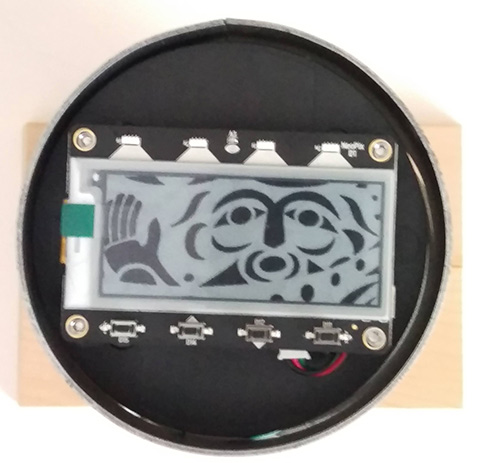
    Using the Adafruit Adabox #017 I added leds and an e-ink display to a lasercut lightbox made of steel by Coast Salish artist Xwalacktun as a gift this year.

    A miniature version of He-yay meymuy (Big Flood), it’s 30cm tall with an 11cm diameter. The original piece is an impressive 487.8cm tall by 167.6cm made of aluminum. Located at the entrance to the Audain Art Museum, it’s is a powerful piece inside a beautiful building.

    I used a metre of RGB neopixels wrapped around a cardboard tube, diffused with the bubblewrap, and plugged into the Adafruit Magtag to animate rain. In this mode the lightbox will eventually fill to a full blue colour.

    There are three other modes with different colours and animations using the Adafruit_led_animation library. Each mode animates differently and updates the e-ink display with a section of art from the lightbox.

    Adafruit MagTag eink display
    Top View: With e-ink the last image will remain, even after removing power.

    I even upcycled the spool from the neopixel strip to mount the MagTag as it fit snuggly. There are plenty of other features I’ve yet to take advantage using built in Wi-fi, light sensor, etc.

    Art by Coast Salish artist Xwalacktun
    296 x 128 px Indexed Colour .BMP used to display on e-ink

    The base is made with glued pieces of western red cedar to mimic the architecture of the museum and carved to receive the artwork.

  • Grow Conference 2014

    grow
    I just attended the Grow Conference here in Whistler and I wanted to share a couple thoughts.

    Billed as “an experiential playground exploring the future of innovation, growth and entrepreneurship” the conference tagline is LIVING IN A CONNECTED WORLD. These themes are near-and-dear to me so I was thrilled when they announced they were coming to Whistler this year. Offering a Lean pass, I was able to secure a fair priced ticket without the need to pay for transportation etc.

    The conference, which took place at the Fairmont Chateau Whistler, was well organized and aside from a couple audio and scheduling issues, everything ran smooth. Along side the conference was a two day hack-a-thon. The challenge; To create a “connected” resort town! I wish it preceded the conference so that I could participate in both.

    The mix between technical and non-technical attendees kept the discussions mostly high-level. The people I tended to connect with were lower-level developer types. With my poor entrepreneurship skills, I was unable to secure millions of dollars in venture capital. I wasn’t actually trying to sell anything. Except maybe Whistler. I would offer local advice, help every lost attendee, and generally just say “how awesome is this place eh?”. I probably wouldn’t have turn down 100k for my idea to start a hackerspace here in Whistler. In fact, I am trying to start a hackerspace right here in Whistler. Sadly, this town isn’t filled with geeks. Only few local tech companies like Guestfolio and Ridebooker here in Whistler and they represent a small percentage of the employers. No reason this can’t increase.

    A few highlights and common themes;

    Wearables and Internet of Things – These are definitely the hot topics getting all the attention. The Internet of Things (IoT), which everyone mutually agrees is a poor term, seems what you call any connected device that’s not a computer. Wearables, obviously are worn. Think Google Glass, Recon Instruments, fitbit, Nike+, etc.

    Privacy and Security – These topics always come up immediately afterwards. As soon as you think “Cool, I can open my door from the internet” you realize that theoretically anyone else can too. That sleep monitor, check-in data, and all the things tracking you for convenience can be mined or interpreted and used against you. My opinion is those that take this serious will win out.
    I was very impressed with SmartThings founder Jeff Hagins opinion on the subject and glad they are staying separate from Samsung after just recently being acquired. I can’t say the same for lax attitude of Life360, whose founder repeatedly made broad statements like “I don’t think your average user cares”. Their product GPS tracks family members btw.

    Data – Data, Data, everywhere data. It’s not enough to just collect it, you need to use it. Inform.
    Scale, infrastructure, APIs and the other things that were once hard have since been figured out. Some companies whole business is collecting customer data. Once you have the data… (see Privacy and Security)

    Best talk and what resonated with me most was Scott Jenson’s How to make everything discoverable with the Physical Web.
    In it, he smartly discussed how the physical web will need a mechanism unlike the current app model. The idea that every future smart-thing would require it’s own smart-app obviously has flaws.
    Just Google “app fatigue” and you’ll see for the past year or so the world isn’t very appy anymore. Yay web! And that’s the idea, broadcast URI’s, no passive tracking. I’m looking forward to experimenting with this. You can too. Find out more with examples on GitHub.

    Overall it was a great conference. I hope to be back again next year.

  • PABLO

    Pablo is a physical chatbot. An open source social robot.

    Pablo got his name from (PyAIML Arduino Bluetooth Low-Energy Object) or something like that.

    1. A Python program running on a host computer accepts input from a web form.
    2. Input is interpreted using Artificial Intelligence Markup Language (AIML)
    3. Response is sent via Bluetooth and spoken by Pablo.

    Pablo is open source software and hardware. Code can be found on GitHub

    He can be found on Twitter here https://twitter.com/pablo_robot

    Using the basic PyAIML example plus a simple webpy form we are able to talk to PABLO. I still need to get the text-to-speech Javascript API working. I was using the speech-to-text input feature in Chrome (x-webkit-speech) but it has since been deprecated.
    AIML responses are constructed from a set of reduced answers to planned questions. eg. “What’s your name?” “Who are you?” “What are you called?” = PABLO.

    NOTE: The USB cable in the eye is a temporary 5v power source only.
    Not quite Natural Language Processing but with random responses and recollection it can make for a convincing conversations.

    On the physical side of things, PABLO is made up of:
    Pablo in pieces

    (Clockwise from top right)
    Arduino Duemilanove microcontroller (Or any compatible)
    Adafruit BlueFruit EZ-Link Bluetooth Shield
    Emic2 text-to-speech Module
    1000 mAh Lipo battery
    2 Adafruit NeoPixel rings (I’m using one 16 and one 12 pixel)
    Adafruit 3v Trinket
    Adafruit 4-channel I2C-safe Bi-directional Logic Level Converter
    2 Hobby servo motors with Pan-tilt brackets
    Cardboard head with wire-spool LED diffusing eyes
    8 Ohm speaker

    An Arduino with the Adafruit EZ-Link Bluetooth Shield receives the response from the host computer. The response is interpreted then commands issued to eyes, servos, and speech module. I used the proto area of the shield to connect headers to which I can temporarily plug in the text-to-speech module, two servo motors, and the level converter connection to eyes.

    The eyes are controlled by a small microcontroller from Adafruit called the Trinket and is powered by the lipo battery. They are self supported and can easily be repurposed for other projects. I used a 16 pixel ring and a 12 pixel ring which made some of the eye functions a little specific to this build. The logic level converter is used to receive commands over I2C from the 5v Arduino microcontroller using the Tinywire library.

    Pablo

    Everything is currently crammed into a cardboard box with a speaker pointed down into the mouth. A talking function randomly moves the jaw servo while Pablo is talking, opening and closing the mouth. This combined with the advanced settings of the Emic2 voice module make for endless hilarity. A second servo twists the head briefly, as one might picture a confused dog, when an answer is not known. The datasheet from Parallax(PDF) shows you how to change the basic settings and take advantage of the more powerful DECTalk processor.

    Lots of things to build on, still tons to do, least of which is his “personality”.

    I plan to document more of the details and code as I go because today I’m hoping Pablo can help me win a trip to space! If not, he’s about the size of a CubeSat and I’ll send him into space.

    UPDATE: Pablo was honoured to make an appearance on Adafruit’s July 23rd Show and Tell!

  • Solar Charging Hydration Pack

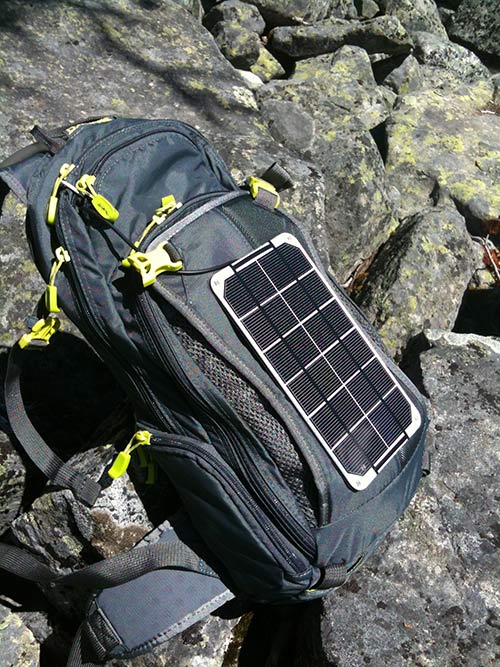
    Solar hydration pack

    Successfully tested the 6V 3.4W solar panel I added my Dakine Hydration Pack. It kept me quenched and full of juice. I took a motorbike ride up Duffey Lake Road and hiked Joffrey Lakes. One the most beautiful places on earth if you ask me.

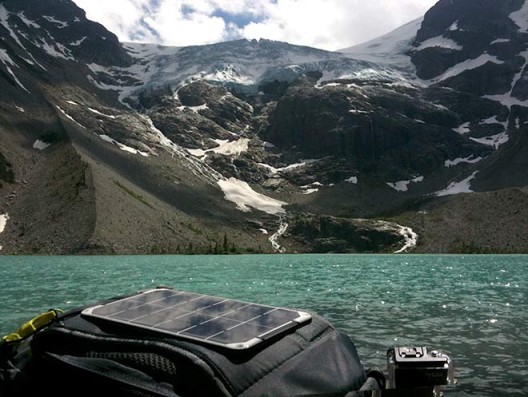
    Joffre Glacier Solar Pack

    With the motorbike pointed North (panel on my back south facing) I was able to charge up my old iPhone’s battery and keep it running all day as well as top up a GoPro for a long timelapse by the lake.

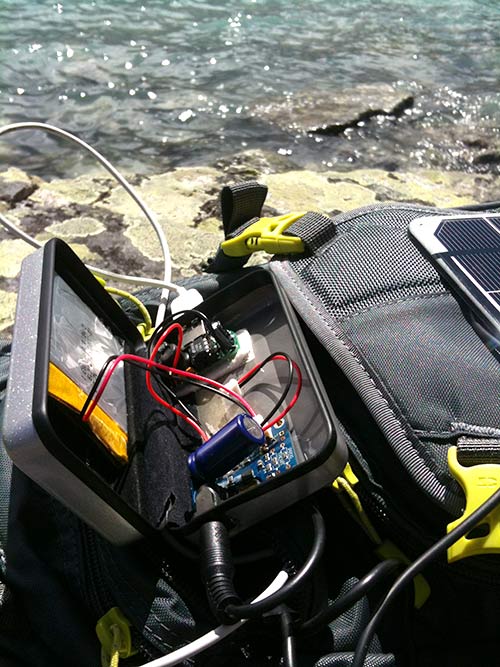
    Solar components

    Using Adafruit kits and the tutorial provided, I had the two kits soldered and secured in an enclosure in about an hour. I’m using a nice clam-shell box from a Swiss army knife to hold everything and as a bonus, The 2700mAh 3.7v LiPo snuggly press-fits into the soft lining.

    Next steps are to move over the Flora and GPS from my winter glove project.

    Solar panel on hydration pack

    Go forth! Let there be light!