I’ll admit I’m a HUGE believer of advances in Artificial Intelligence. Deep learning or just general machine learning. From Bayesian beginnings to GANs and CNNs, I’m all about data, ML and all of the promises it’s future holds. The problems it can solve today seemed impossible just 10 years ago. So naturally when I learned of the 2021 release of Atlas of AI I immediately ordered it.
When it arrived I dove into the text, eager for more knowledge and understanding in this exciting field.
But instead of excitement and being a sponge for fresh knowledge, I found the first chapters draining. Like earth-depleting depressing. At first I pushed back in my mind – “Not that bad” etc.
Honestly I think in my exuberance I didn’t even read the book’s subtitle “Power, Politics, and the Planetary Costs of Artificial Intelligence”. I know there is a cost to all technology and literal or figurative “mining” excel at wasting resources, stressing environments but I wasn’t ready to read more doom and gloom at that time. The book went on the shelf.
Fast forward over a year later to my first fossil-fuelled odyssey in three years. A 10,000 km round-trip flight, 10+ hours in the air and I need a book…
ROUND 2: I began Atlas of AI again and re-read those first chapters with much less scrutiny, bias, and a far more open mind. As someone who has paid to use heavy GPU time on Colab to generate frivolous, yet remarkable images, I may need to look in the mirror.
Once I shed my reactionary defence of all things ML I began to understand and even appreciate the author’s point of view. I do believe many corporations will also begin to weigh ethical and environmental costs of Artificial Intelligence.
Today’s announcement by Microsoft to retire facial inference of emotional state is just one instance where I see more companies coming to terms with the ethics of AI. Perhaps guided by this book.
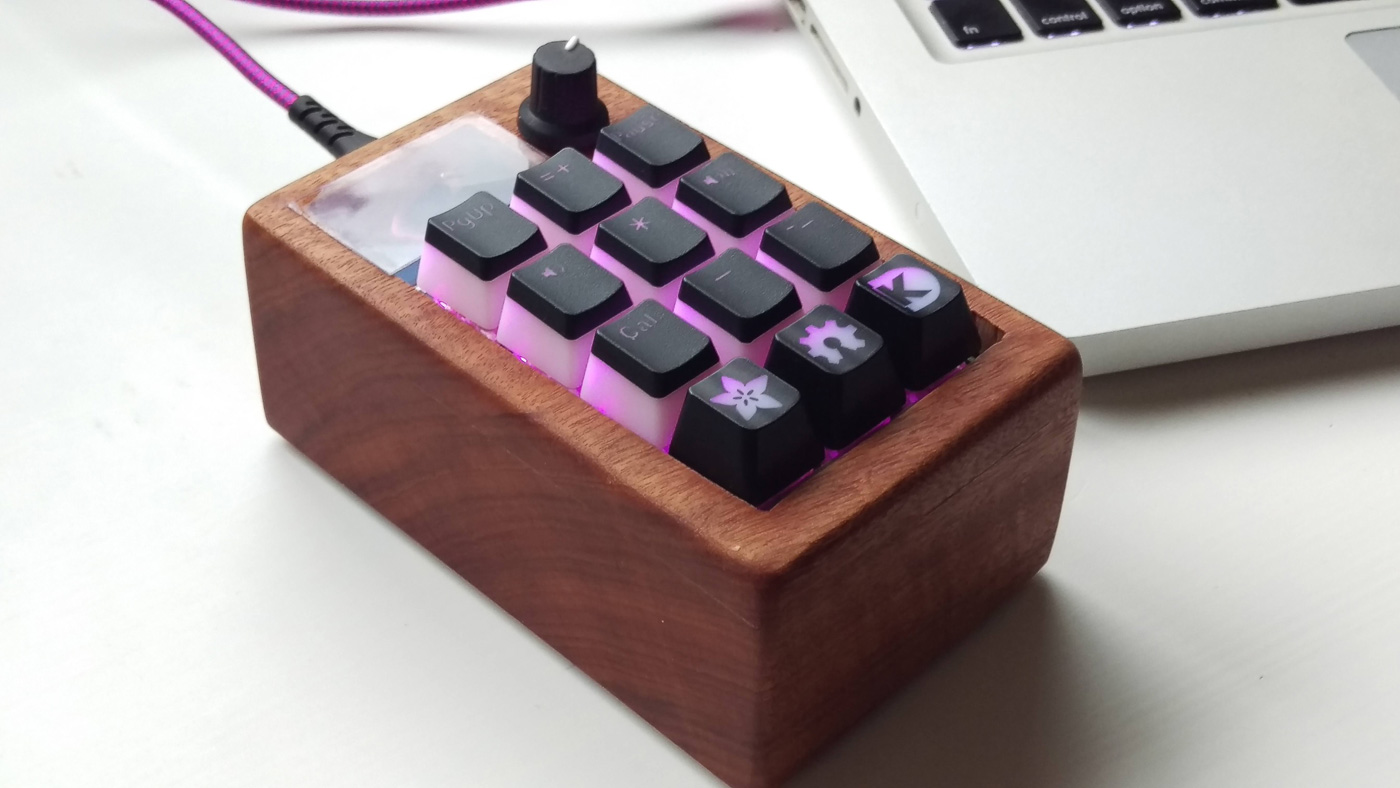
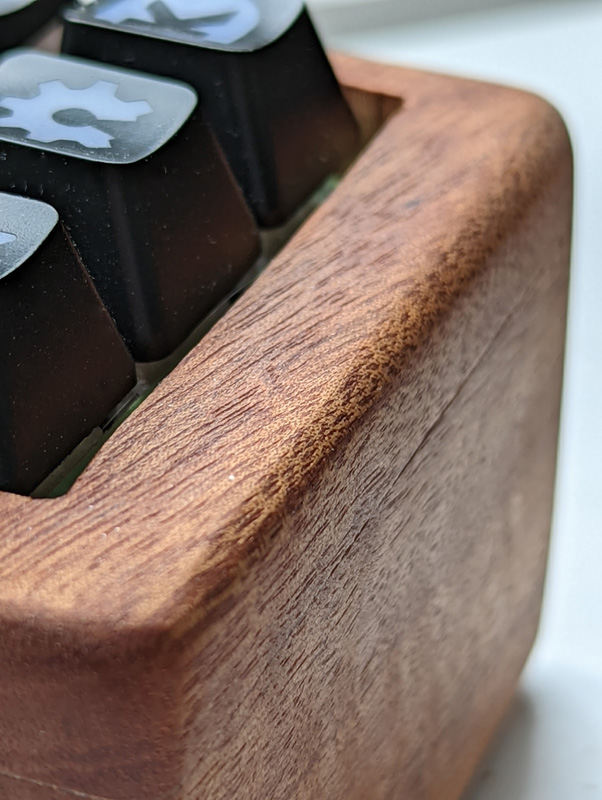
It’s an open source electronics kit, the Adafruit Macropad, embedded in a solid block of quarter-sawn tigerwood.
What can it do?
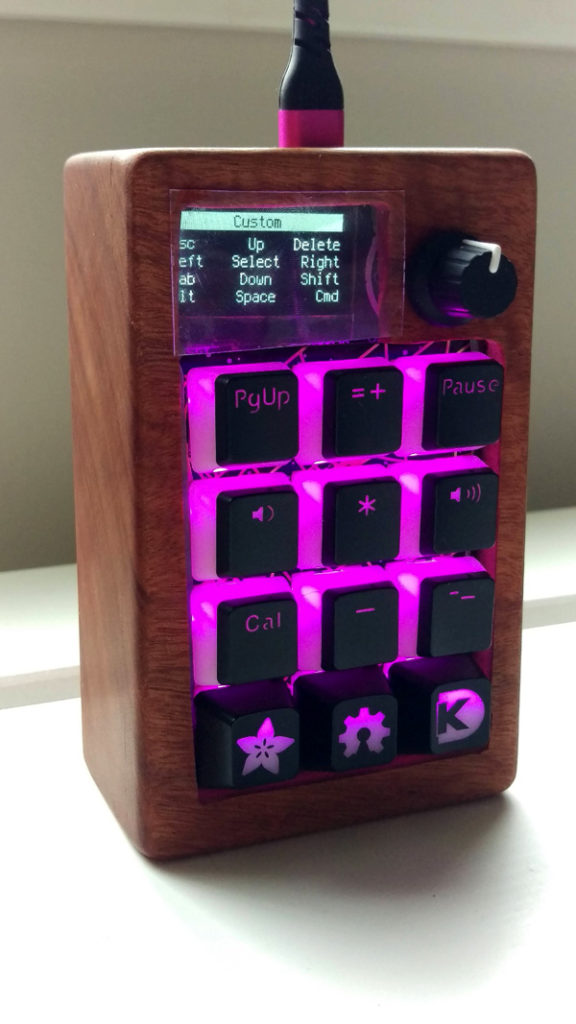
It’s a programable HID keyboard with OLED display and rotary encoder running CircuitPython. Which is a hardware specific, light-weight port of Python for microcontrollers. The keys have RGB LEDs and can be programmed to send single or multiple keystrokes to the computer.
It shows up as a mountable drive, you can live-edit the code.py file so when you save, the new code is automatically loaded. No compiling.
Similar to other computer mice, keyboards, or other peripherals it’s powered by USB so it does not run standalone.
The Woodworking began as a solid block of South American Tigerwood. Nice pattern and hardness but I can’t say I enjoy the smell of this wood. It’s got a gluey stank which is not particularly enjoyable.
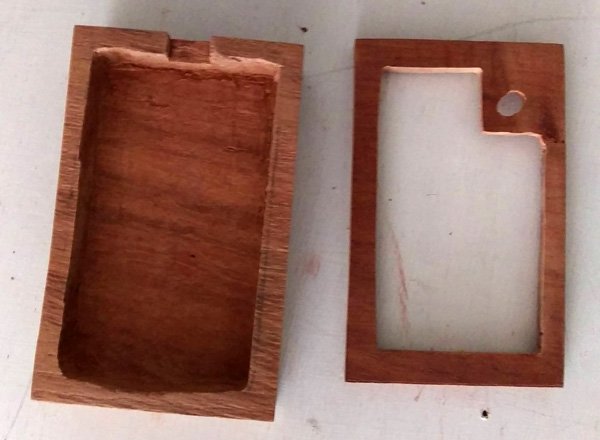
I used a bandsaw to take a 1/4 inch veneer off the top. This will be the cover.
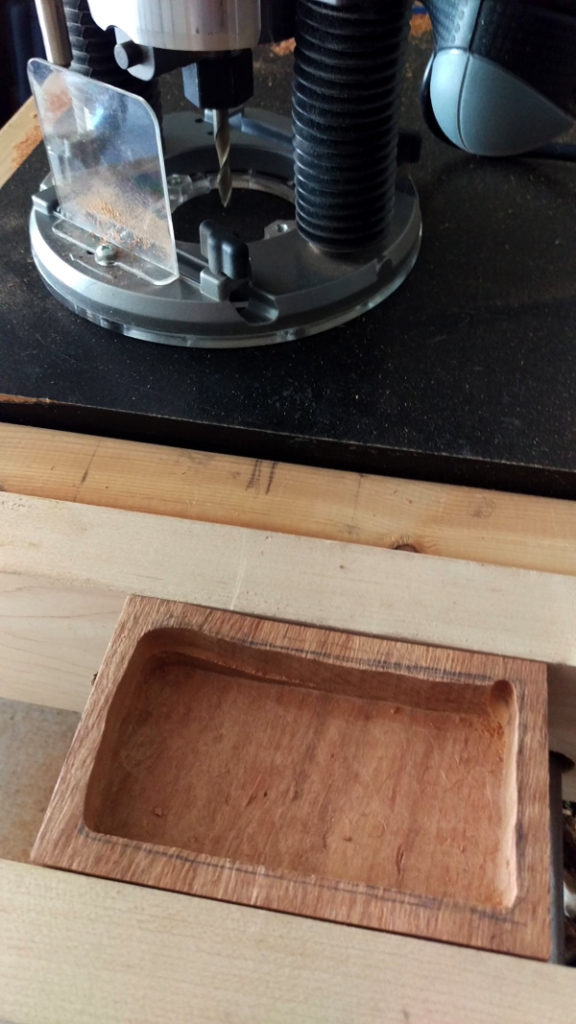
The bottom base was hollowed out using a plunge router. A device you must respect. It can clear out a lot of material quickly but at 10k to 30k RPMs it can easily get away from you in a hurry. Safety always first.
The two two pieces were then carved and fitted to accept the Macropad. It’s a bit of a shame to seal up the beautiful silkscreen art of this particular PCB.
The fitted Macropad had one other addition. I used a cut down credit card sized plastic magnifying glass using lenticular? magnification. The offset from the OLED gives the display a slight floating feeling.
Macrophotograpy of the Macropad
The project was finished with a couple coats of MInwax Tung Oil finish. Not a “true” tung oil but it makes the grain pop while not filling the wood pores.
The seams are a little more visible than I would like. From a distance however it’s not that noticeable. I’ve learned that minimal handling is required after separating using the “bandsaw box” technique to prevent “dings”.
As for programming I’m mainly using the application hotkeys demo found on the Adafruit Learning Guide but the sky is the limit because it can be programmed to do anything a keyboard or mouse can do.
I’ve been really impressed with the Merlin App for Android Sound ID. There have been a few birds that I have not been able to spot or identify visually but using Sound ID I can quickly pull up and confirm which bird I’m hearing.
The Pacific Wren has an amazing song and I noticed for years the calls but I’ve still yet to see one. Also particular impressive was it’s recognition of the Stellar’s Jay non-screechy vocalizations.
Every so often I’m motivated to move my online content in-house. With todays purchase of Twitter my intent to “own” my content has been renewed.
Dropping Twitter – A 2008 animation I made of the “Fail Whale”. (Original artist illustration = http://www.yiyinglu.com/?portfolio=lifting-a-dreamer-aka-twitter-fail-whale)
I’m going to clean up my old Feedly RSS subscriptions and try posting here a bit more frequently. You can subscribe if you like – https://www.somenice.com/feed/
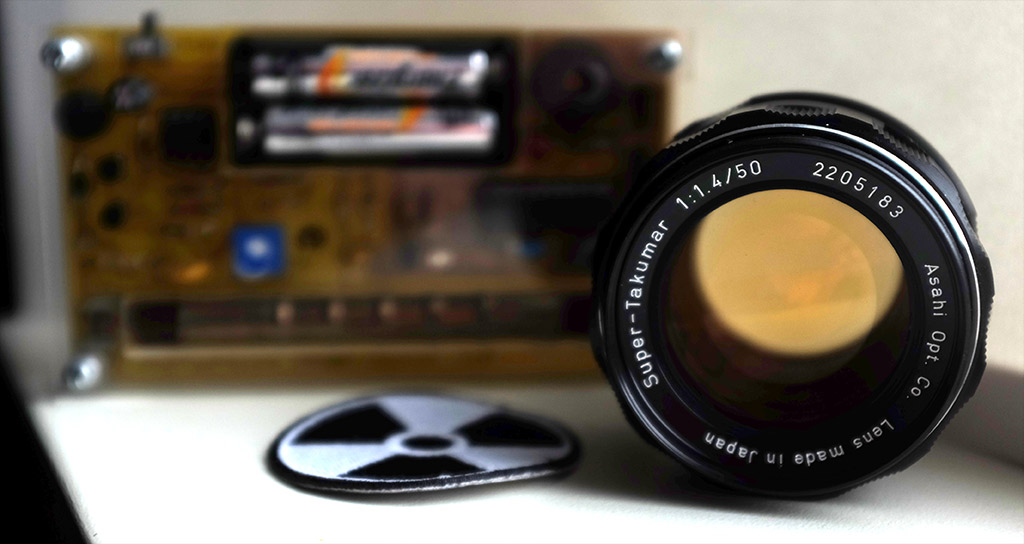
The Super-Takumar 50mm f1:1.4 and Mighty Ohm Geiger kit The yellowing of the lens caused by the radioactive decay.
Last week marked the ten year anniversary of the Japanese earthquake and resulting tsunami that caused the Fukushima Daiichi nuclear disaster.
In the years following that tragic event, flotsam began arriving on the Pacific West Coast. Volunteers making great effort to return personal items back to family and loved ones in Japan.
Models showed the ocean currents and their possible nuclear contamination as it crossed the Pacific Ocean.
My interest in sensors and environmental monitoring led me to the relatively inexpensive Mighty Ohm Geiger Counter kit. A fun open-source microcontroller-based Geiger counter kit you solder together yourself.
Years ago I began collecting vintage film cameras, still occasionally shooting and developing my own B&W film today. Ebay was a great source for these antique objects of optical and mechanical precision, which were practically given away in the early days of the digital camera’s rise. Some film cameras are still sought after for collectibility and some manual focus film lenses got a new life with the use of adapters on digital cameras.
While I had an interest in detecting any increased environmental radioactivity from the event as a citizen scientist, my main motivation was testing old film camera equipment.
One of my favourite Ebay film camera purchases that I still use today is the Asahi Pentax Spotmatic SP. I got it as a “kit” with a large assortment accessories and quality lenses. At nearly 60 years old, these Super-Takumar screw thread M42 mount lenses have such a precise feeling. The range of prime lenses in this purchase included: Wide angle 28mm f3.5, Zoom 135mm f2, and Fast 50mm f1.4.
Small yet surprisingly hefty, the only way I can describe the focus dial is like the volume knob on an expensive stereo. Smooth resistance. The aperture dial clicks into each stop without wiggle. Lens covers are friction-fit without mechanical fasteners, hoods and cases, straps all immaculate condition and with such tight tolerances. I need a thesaurus for additional words for “precise”.
From this camera, and the 50mm f1:1.4 specifically, I created one of my personal favourite pictures of all time.
I have however heard stories of some lenses being radioactive and also that some cameras may have been looted from nuclear contaminated sites such as Chernobyl. In the late ’90s my camera of choice was a lomo smena 8m. Used mainly backpacking, there is really no lighter fully manual 35mm camera.
There are plenty of forums, articles, and Youtube vids, listing/discussing radioactive lenses. Thoriated glass was used for it’s optical properties perhaps before the effects of prolonged exposure to radiation were fully understood. While many dismiss the risks associated with owning or using this radioactive equipment, I’ll leave it for the reader to make their own informed decisions. A comical radiation dose chart from XKCD.com
I’ll admit, until I had a source of beta or gamma radiation, my geiger counter was essentially a really great random number generator. Blip… blip….blip. blip
My radiation detector is capable of detecting beta and gamma radiation but alpha radiation can not detected. A bit more reading about Thorium232 tells me that it actually decays emitting alpha radiation though.
Hang on, what’s going on?
Turns out the decay chain releases a “cascade” of fun alpha, beta, and gamma particles. The latter saturating the Geiger-Mueller tube sensor.
From the serial monitor getting close had the following readings: CPS, 18, CPM, 1080, uSv/hr, 6.15, FAST
Though detectable only close to the source, it’s hard to read these kind of numbers and say I want to go out and hold this up to my face for half a day.
And keep it the house with my family for years to come? Nope. Topes lose, Topes lose.
I wouldn’t even consider selling this lens at this point, even to someone who fully acknowledges the risks. Because while they might accept it, the logistics people, delivery drivers, shippers or anyone in between didn’t agree to that.
Question is, where and how do you dispose of this hazardous, gorgeous, and “precise” material?
UPDATE: I’m now in touch with the Historic Artefact Recovery Program (HARP) Operated by Canadian Nuclear Laboratories (CNL). The HARP provides technical advice, assistance, identification and management of radioactive artefacts found on public and private properties across Canada. Where necessary, the artefacts are transported to a licensed long-term storage facility located at CNL’s Chalk River Laboratories in Chalk River, Ontario.